

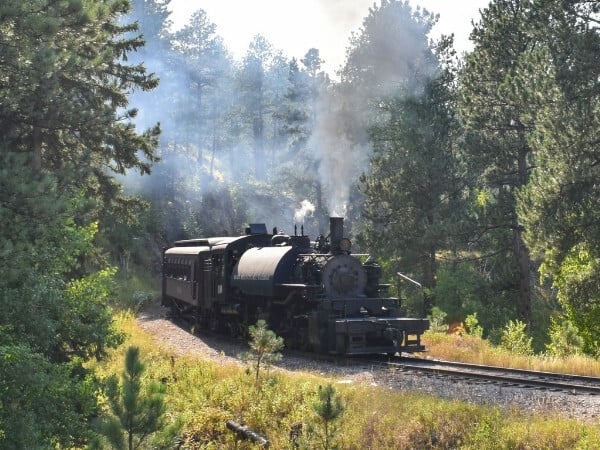


In a world of constant distractions, the 1880 Train offers the slow path, moving with purpose along a route with natural splendor and reminders of our frontier past. We invite you to join us and reconnect with the beauty of the world. Curious about what you’ll see? Here are just a few of the sights and natural splendor along our routes in the Black Hills of South Dakota.
Manmade and Natural Wonders
Each mile on the track gives you something new to see and learn about. The Hill City Station began in 1875 as a mining camp. Departing from Hill City, the train ascends one of the steepest grades in the U.S., and you may see Spring Creek to your left running through one of the city parks. In a couple of miles, you’ll catch the remnants of Addie Camp, once a thriving community of miners and their families but now a ghost town.
Coming into Palmer Gulch, don’t miss your second, picture-perfect view of Black Elk Peak to the south. You’ll also get a glimpse of aspen and birch trees on this stretch of track. A couple of miles later you’ll notice the tranquil Leaky Valley, named for its numerous natural springs, and nestled beneath the towering Elkhorn Mountain to the south.
Next, you will see the towering Harney Granite cliffs to the north. As you go down the canyon, Old Baldy Mountain is in the distance at 5,500–feet tall. Do you see a tall, wooden cross erected on top of a hill to the north? Across from that is Camp Judson Baptist Camp which rests on the site of the old Pine Camp community and the Overgaard Sawmill. Don’t miss Battle Creek waterfall to your left. Several different trees come into view, including bur oak, Black Hills spruce, birch, aspen and more.
Later, as you pass Echo Valley’s mouth, you’ll be within a mile of Mount Rushmore National Memorial, although the faces aren’t visible from the train. What will be visible is Kemp’s Kamp, where visitors enjoy waving at the train — be sure to wave back! Just a bit further, to the south is Lafferty Gulch, once a mining community, now a group of summer homes. In this area, the train pulls through the longest and deepest cuts in the rock. Try to catch a glimpse of the many marmots (sometimes called woodchucks) running along the tracks.
Coming to the end of the line is the town of Keystone, created at the turn of the century to work the Holy Terror Mine. It is from here, along Highway 16A to Highway 244, that leads to Mount Rushmore National Memorial.
Birds, Trees, and Rocks
All along the route you’ll see nature in all its glory. Some of the birds you’re likely to see include mallard ducks and wild turkeys. And yes, these turkeys can fly! There are plenty of deer, but with a running speed up to 30 miles per hour you may need to watch carefully. They may be darting among the quaking aspen, tall trees whose leaves flutter in the wind and have a shared root system. In the spring the Pasque flower blooms, beautiful purple wildflowers which are also the official state flower of South Dakota. Other trees you’ll spy include the bur oak, aspen, birch, and of course the mighty Ponderosa pine – the most abundant tree in the Black Hills. The Black Hills spruce, a subspecies of the white spruce, is unique to the area and the official state tree of South Dakota.
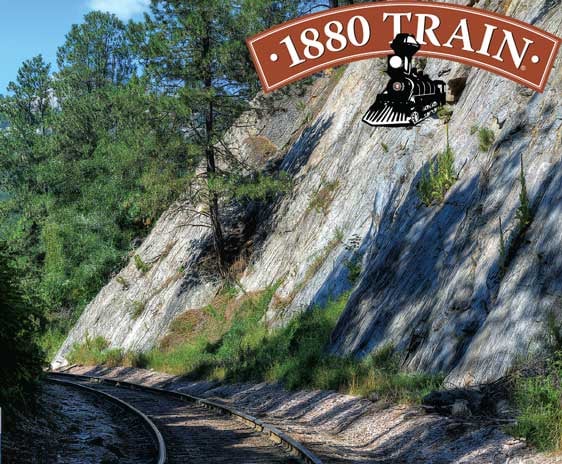
You’ll notice lots of geological features along the route, most of which are granite, a tough mineral created deep beneath the Earth’s surface. When the Black Hills were formed, this granite surfaced, bringing valuable and useful minerals with it — like beryl, quartz and mica. Aside from the gold rush, this is why so many mines exist around the route. Tin, tungsten, gold, antimony, arsenic, barite, beryllium, cesium, fluorspar, graphite and other minerals have been mined throughout the area.
The Black Hills are home to a diverse array of wildlife, and if you're lucky, you might just spot some of these fascinating creatures during your journey on the 1880 Train.
Preserving the View
While traveling through the Black Hills, you may spot piles of branches and organic matter stacked neatly along the forest floor. These "slash piles" are part of an essential forest management effort to prevent wildfires. By thinning the forests and removing excess fuel, National Forest staff and private property owners promote healthier, more resilient ecosystems, which allows the remaining trees to flourish. These piles are carefully regulated and monitored.
At the 1880 Train, we cherish the natural wonders along our tracks and believe in being good stewards of the land. Many thanks to everyone who helps keep nature beautiful and guards it from hazards like wildfires.
Although the train is the main character in this story, nature surely does put on a show no matter what time of year you visit. We know you’ll love the views along the way, so why not join us and see how awe-inspiring they are in person? If you’ve booked a round-trip ticket, you’ll get twice the time to experience these natural wonders!